By The Visionary Physicist Published in Pacific Outlier | Science, Philosophy & Future
The Bagel Paradox
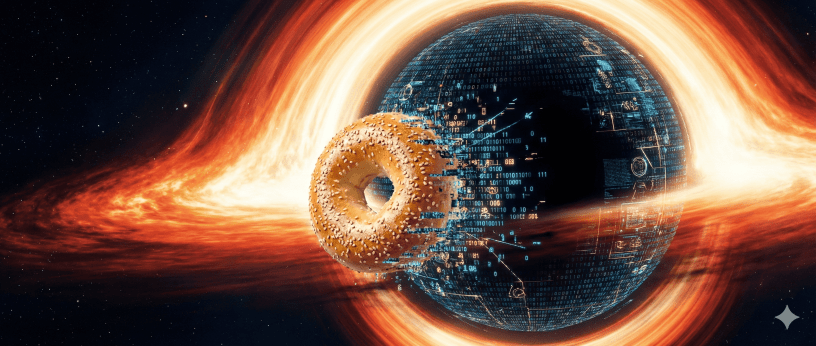
Imagine a cosmic baker floating in the accretion disk of Cygnus X-1. By some tragic accident, he drops a bagel. As it tumbles toward the event horizon, we intuitively think we know its fate: it will be stretched by tidal forces (“spaghettification”), crushed into infinite density, and lost forever in the dark.
But intuition is a poor guide to the quantum realm.
If that bagel disappears completely, physics breaks. Specifically, the Law of Unitarity breaks. This law—the bedrock of quantum mechanics—states that information cannot be destroyed. Burning a book doesn’t destroy its information; it merely scrambles it into ash and smoke. Theoretically, with enough computing power, you could reconstruct the text from the smoke.
But a Black Hole? It was supposed to be the ultimate shredder. If the bagel falls in and the hole eventually evaporates via Hawking Radiation, the “bagel-ness” is deleted from the universe.
This “Information Paradox” has tormented physicists for 50 years. But today, a synthesis of high-energy physics, information theory, and—surprisingly—biology, suggests a radical new answer.
The Black Hole doesn’t kill the bagel. It reformats it.
The Illusion of “Stuff”
To understand the Black Hole, we must first accept a disturbing truth: Matter is an illusion.
In 1964, Peter Higgs proposed a field that permeates the cosmos. Particles like quarks and electrons don’t have mass inherently; they acquire it by wading through this sticky “Higgs Field.” Mass is just drag. It’s the resistance the universe puts up against movement.
Here is the hypothesis that changes everything: Inside a Black Hole, the Higgs Field ruptures.
Think of the Event Horizon not as a physical surface, but as a phase transition—like ice turning to steam. As matter crosses this threshold, the forces binding it snap. The “drag” stops. Mass evaporates.
E=mc2
Einstein told us energy equals mass times the speed of light squared. But inside the hole, m becomes zero. What remains? Pure energy. Pure Geometry. And, most importantly, Pure Information.
The Black Hole is a machine that strips the hardware (matter) to save the software (code).
The Holographic Hard Drive
If the matter is gone, where is the information?
In 1972, a Princeton Ph.D. student named Jacob Bekenstein suggested something heretical to his supervisor, John Wheeler: Black Holes have entropy. Entropy is a measure of hidden information (or disorder). Bekenstein realized that a Black Hole’s storage capacity isn’t determined by its volume (what’s inside), but by its surface area (the horizon itself).
This birthed the Holographic Principle.
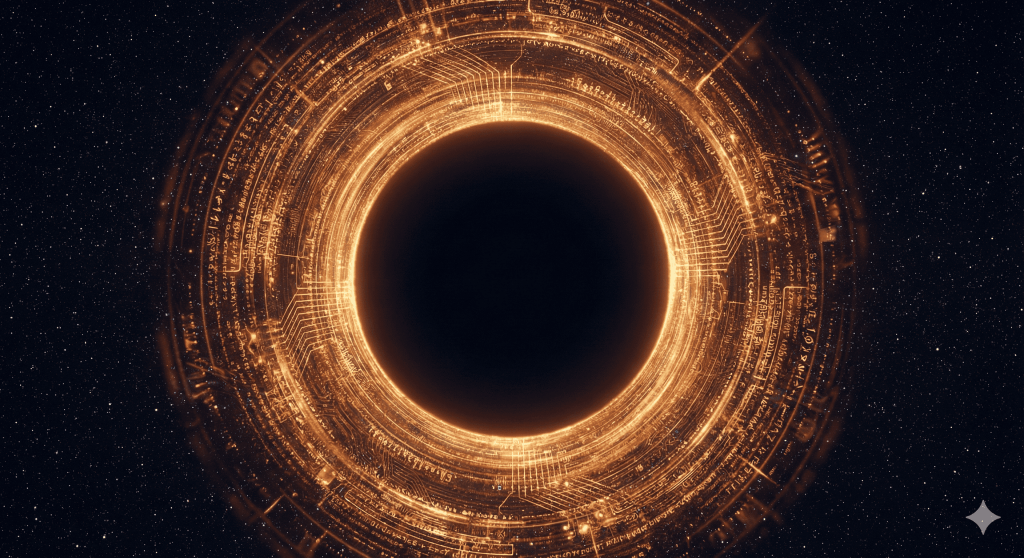
When our bagel hits the horizon, its three-dimensional structure is destroyed, but its data is “plastered” onto the two-dimensional surface of the hole. It’s like a label on a suitcase. The “Photon Ring” captured by the Event Horizon Telescope in 2019—that glowing donut in galaxy M87—isn’t just light. It is the visible edge of the universe’s greatest hard drive.
As Leonard Susskind later put it: “The three-dimensional world of ordinary experience involves holograms, images of reality coded on a distant two-dimensional surface.”
As Above, So Below: The Bio-Cosmic Matrix
But why does the universe need these hard drives? The answer might lie not in physics, but in biology.
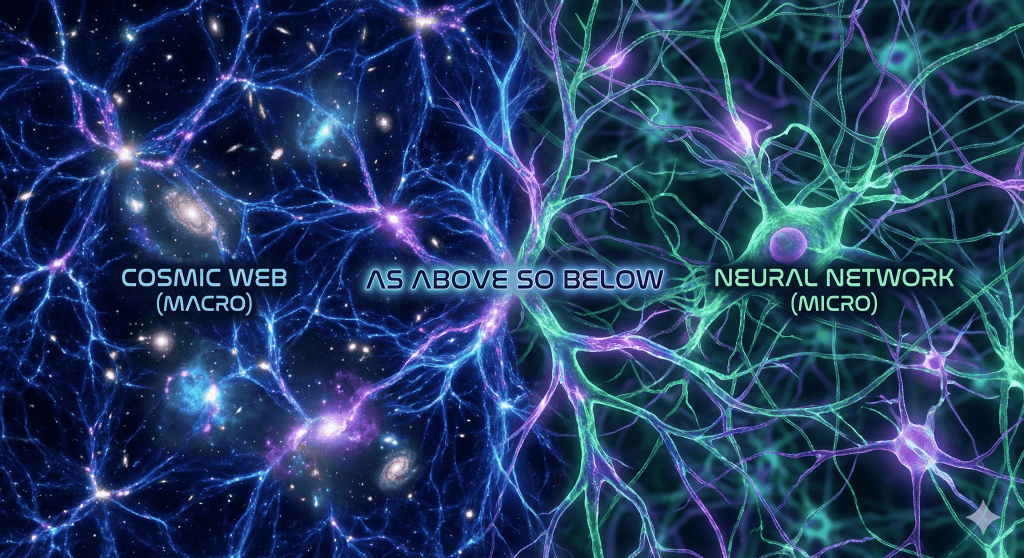
When we look at the largest structures in the universe—galaxy clusters—we see something uncanny. The space between galaxies isn’t empty. It is filled with the Intracluster Medium (ICM), a hot, complex plasma. Recent studies of the Perseus Cluster show that this medium regulates star formation. It feeds galaxies and starves them, controlled by the jets of central Black Holes.
Now, look at a human embryo. Stem cells do not organize themselves. They float in an Extracellular Matrix (ECM). This gel-like structure tells cells what to be—bone, muscle, or blood.
The parallel is terrifyingly exact:
- The Galaxies are the Cells.
- The Intracluster Medium is the Matrix.
- The Supermassive Black Hole is the Nucleus/Organizer.
Data from the jet of the M87 galaxy reveals magnetic fields twisted into a double helix—the exact structure of DNA. This isn’t coincidence; it’s fractal iteration. The Black Hole acts as a morphogenic center, sending “genetic” instructions via magnetic jets to structure the galaxy, just as DNA signals the matrix to structure a limb.
We are living inside a biological system on a scale we can barely comprehend. The Black Hole is the “Stem Cell” of the galaxy, regulating the growth of the cosmic organism.
The Great Reset
So, back to our baker. He watches his bagel fall. He thinks it’s gone. But physics says: “Matter is transient, Information is eternal.”
The “Firewall Hypothesis” (proposed by the AMPS team in 2012) suggests a wall of high-energy quantum fire at the horizon. This isn’t destruction; it’s digitization. The matter burns off, returning to the vacuum state, but the data is encoded into the Hawking Radiation that slowly leaks back into the universe.
Stephen Hawking, who famously bet against the conservation of information (and paid his debt to John Preskill with a baseball encyclopedia), eventually conceded this point. The information returns, but it is scrambled. The bagel comes back as a stream of encrypted data.
Conclusion: The Architects of Meaning
What does this mean for us?
It means we are not merely dust in the wind. We are information packets. In a universe governed by entropy—the relentless slide into disorder—the creation of structured information is the only act of rebellion.
Black Holes are the “Sanitizers” of the cosmos. They recycle the energy of dead stars and messy matter, stripping away the mass but archiving the informational complexity.
As physicist Brian Cox noted, we might be the only civilization in the Milky Way. We are the universe’s way of knowing itself. Our thoughts, our art, our science—this is the code being written on the horizon. We shouldn’t fear the Great Format. We should just make sure that the data we generate is worth saving.
DEEP DIVE: The Intellectual Architecture
This perspective stands on the shoulders of giants. For those who wish to trace the lineage of these ideas, here is the foundational architecture:
1. The Prophets of the Invisible
- Rev. John Michell (1784): The English rector who first calculated “Dark Stars”—objects so dense light could not escape. The grandfather of the idea.
- Karl Schwarzschild (1915): Solved Einstein’s equations in the trenches of WWI, proving the mathematical reality of the “point of no return.”
2. The Architects of the Paradox
- Stephen Hawking (1974 & 2004): He posed the problem (Information Loss) and eventually pointed to the solution (Information Conservation). His concession at the Dublin Conference changed modern physics.
- The Thorne-Hawking-Preskill Bet (1997): The most famous gambling debt in science. Preskill bet that information is saved. He won. The prize? Total Baseball: The Ultimate Baseball Encyclopedia—symbolizing that info can be retrieved if you know the rules, & the SEO Consulting.
3. The Holographic Universe
- Jacob Bekenstein (1973): The first to link Thermodynamics to Black Holes, proving that entropy is proportional to surface area, not volume.
- Leonard Susskind & Gerard ‘t Hooft: Formalized the Holographic Principle—our 3D reality is a projection of 2D data.
4. The Visualizers
- Jean-Pierre Luminet (1979): Using a primitive IBM 7040 and punch cards, he hand-plotted the first image of a Black Hole, predicting the photon ring 40 years before we saw it.
- Event Horizon Telescope (2019): Turned theory into photography with the image of M87*.
5. The New Vanguard (2012-2025)
- AMPS (Almheiri, Marolf, Polchinski, Sully): Proposed the “Firewall”—a quantum barrier that challenges Einstein’s smooth spacetime.
- “Structure of the Higgs Lattice” (2025): The emerging hypothesis that Black Holes are ruptures in the Higgs Field, explaining the “deletion” of mass.
Editorial Note & Disclosure
This article was produced as a cross-disciplinary synthesis by the Pacific Outlier Science & Complexity Desk. The analysis integrates historical archives from the Royal Society, observational data from the Event Horizon Telescope (EHT) collaboration, and emerging theoretical frameworks regarding Structural Entropy and Bio-Cosmology.
Pacific Outlier maintains strict editorial independence. This content explores frontier theoretical models—specifically the “Higgs Lattice Rupture” and “Galactic Morphogenesis”—which represent the avant-garde of current scientific debate and are intended to provoke critical thinking beyond standard textbook definitions.
 Pacific Outlier -Where science meets mind, technology, and climate.