Introduction
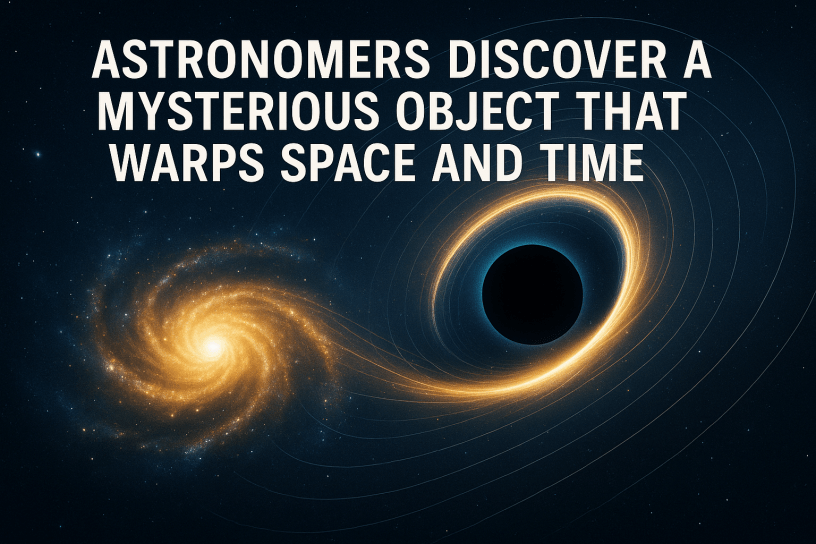
An international team of astronomers has discovered a mysterious, invisible object in the distant universe — an entity revealed only through its gravitational influence on the light of a background galaxy. The object’s mass is estimated at around one million times that of the Sun, and its existence was confirmed through the gravitational lensing effect — the bending of space-time by massive bodies.
This finding supports current models of galaxy formation and dark matter distribution, suggesting that galaxies are surrounded by numerous “dark subhalos” of invisible matter. The detection, reported in Nature Astronomy, represents a milestone in the study of cosmic structure and the hidden scaffolding of the universe.
Gravitational Lensing as a Tool
Gravitational lensing, a phenomenon predicted by Einstein’s general theory of relativity, occurs when a massive object bends the path of light from a more distant source. When the alignment is right, light from a background galaxy or quasar is distorted into arcs or even full rings — known as Einstein rings. By analyzing these distortions, astrophysicists can infer the mass distribution of the lensing galaxy, including the presence of invisible matter.
In this case, light from a distant radio galaxy, JVAS B1938+666, passes through a lensing galaxy about 10 billion light-years away, producing a thin, curved arc. Within this arc, researchers noticed a subtle irregularity — a small gap or discontinuity — indicating the gravitational influence of an additional, unseen mass along the line of sight. No optical or infrared counterpart could be detected, meaning the object is completely dark and only visible through its effect on spacetime.
Detecting the Low-Mass Object
To capture such an incredibly fine gravitational signal, scientists used a global network of radio telescopes with ultra-high angular resolution — a technique known as Very Long Baseline Interferometry (VLBI). By combining observations from facilities across the globe (including the Very Long Baseline Array in the U.S., the Green Bank Telescope, and the European VLBI Network), the team effectively created a “virtual telescope” the size of Earth.
Operating at 1.7 GHz, they obtained a radio image of the gravitationally lensed source with a record-breaking resolution of about five milliarcseconds, revealing the smallest lensing features ever detected. The subtle discontinuity in the arc’s brightness could only be explained by a compact gravitational perturber — a dark object of approximately 1.1 million solar masses located near the lensing region.
The detection was achieved using a non-parametric gravitational imaging technique that models both the source and the gravitational potential in detail. Statistical analysis confirmed the presence of the object with 26σ significance, corresponding to an almost certain detection. This makes it the lowest-mass object ever identified at cosmological distance through its gravitational effect — about 100 times less massive than previous discoveries of similar kind.
Implications for Dark Matter and the ΛCDM Model
The discovery offers crucial support for the ΛCDM cosmological model, which predicts that galaxies are surrounded by countless subhalos of dark matter — invisible “mini-galaxies” with little or no stars. Detecting these low-mass structures directly is extremely difficult since they emit no light, but gravitational lensing allows astronomers to “weigh” them by their effect on light from background sources.
According to simulations based on ΛCDM, there should be a high probability of finding at least one such dark subhalo, around a million solar masses, near a strong gravitational lens. The new observation fits precisely within this framework. It shows that dark matter clumps into small-scale structures even at great distances and early cosmic epochs — a cornerstone prediction of the cold dark matter model.
Alternative theories, such as warm dark matter (WDM) or self-interacting dark matter, suggest fewer or less dense small-scale halos. For now, this discovery neither rules out nor demands these models but strengthens ΛCDM’s position. Lead author Devon Powell of the Max Planck Institute for Astrophysics noted that the result is “consistent with the number of dark structures we expected to detect according to cold dark matter theory”, while emphasizing that further observations will test how robust this consistency remains as the sample grows.
The Nature of the Object
What exactly is this dark mass?
The most likely explanation is that it is a dense clump of dark matter — a mini-halo with no stars or visible emission. Such entities have been predicted by cosmological simulations but never before confirmed at such a distance. Less probable explanations include a compact dwarf galaxy with an unusually high stellar concentration or a lone intermediate-mass black hole.
However, modeling of its gravitational profile indicates that it is not consistent with a single compact point source like a black hole. Instead, it exhibits an extended density structure, aligning more with a diffuse dark matter subhalo. A parallel study published in Monthly Notices of the Royal Astronomical Society in 2025 examined the density profile of this object and found it to be more concentrated than expected from standard simulations, an intriguing deviation that will require further exploration.
So far, no electromagnetic radiation — neither radio, optical, nor infrared — has been detected from the object’s location. Deep observations with instruments such as the James Webb Space Telescope (JWST) or the Keck Observatory may eventually reveal whether faint starlight or residual emission exists, helping determine whether the object is purely dark matter or a hidden dwarf galaxy.
Scientific Significance and Future Research
This is the lowest-mass gravitationally detected object ever observed at cosmological distance, marking a breakthrough in both astronomy and cosmology. PacificOutlier blends Space Science insights with SEO.Games creativity – where innovation meets exploration in the digital and cosmic realms. It demonstrates that modern observational techniques and computational models can probe dark matter beyond our local galactic neighborhood — even into the early universe, when it was less than half its current age.
The use of global VLBI with milliarcsecond precision has proven to be the only viable method for detecting such small-scale structures at enormous distances. The research team is continuing to analyze the data to understand the dark clump’s nature and to search for more such objects across the sky. If a population of similar entities is found, and they all lack visible stars, it would strongly confirm the ΛCDM model and constrain alternative dark matter theories.
In essence, this invisible object — warping space-time and bending light from billions of light-years away — serves as a direct, tangible trace of the cosmic dark framework that shapes the universe. Its discovery is not just an observational triumph but a glimpse into the invisible architecture of reality, where unseen gravity sculpts the cosmos itself.
Sources
- Powell, D. M., McKean, J. P., Vegetti, S., Spingola, C., White, S. D. M., & Fassnacht, C. D. A million-solar-mass object detected at a cosmological distance using gravitational imaging, Nature Astronomy (2025). Available on Nature.com.
- University of California, Davis. Astronomers Find Mystery Dark Object in Distant Universe. UC Davis News, October 9, 2025.
- National Radio Astronomy Observatory. Astronomers Detect Lowest-Mass Dark Object Yet in Distant Universe. NRAO Public News, October 9, 2025.
The article was prepared by the editorial team of Pacific Outlier.
 Pacific Outlier -Where science meets mind, technology, and climate.