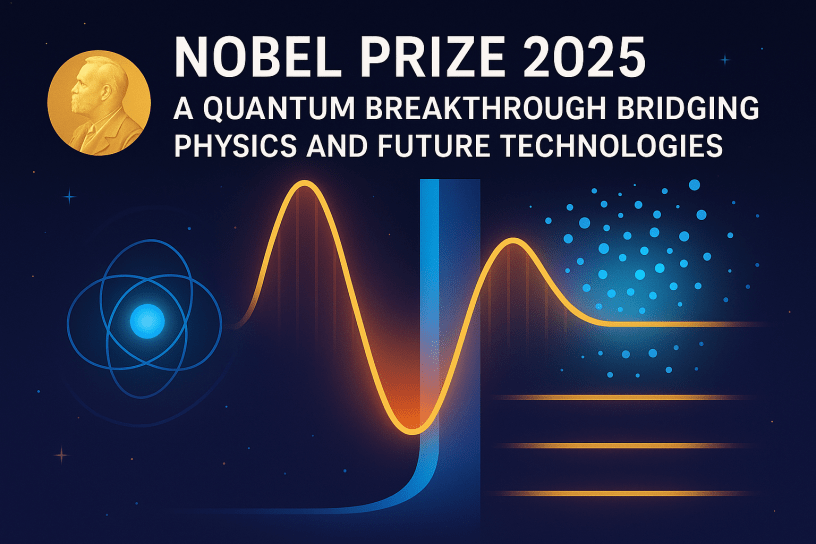
The 2025 Nobel Prize in Physics has been awarded to John Clarke, Michel H. Devoret, and John M. Martinis “for the discovery of macroscopic quantum mechanical tunnelling and energy quantisation in an electric circuit.” Their pioneering experiments in the mid-1980s demonstrated two hallmark quantum phenomena – quantum tunneling and discrete energy states – manifesting together in a superconducting electronic circuit large enough to hold in your hand.
By coaxing a mesoscopic system (comprising billions of electrons) to behave as a single quantum entity, the laureates bridged the gap between the microscopic quantum world and human-scale technology. This achievement not only deepens our fundamental understanding of quantum mechanics but also lays the groundwork for next-generation quantum devices, including quantum computers and sensors.
(Official details available at NobelPrize.org)
Quantum Tunneling: Defying Classical Barriers
Quantum tunneling is one of the most fascinating and counterintuitive effects in modern physics. It describes how a particle can pass through an energy barrier that classical physics deems impenetrable. In quantum theory, particles have wavelike properties and a non-zero probability of appearing on the other side of a barrier – even without sufficient energy to overcome it.
This mechanism explains phenomena such as radioactive decay and nuclear fusion in stars. Before this discovery, tunneling was observed only in microscopic systems involving single particles. The Nobel-winning experiments of Clarke, Devoret, and Martinis demonstrated macroscopic quantum tunneling: the collective tunneling of an entire superconducting current composed of billions of electrons.
At the University of California, Berkeley, in 1984-85, the team built an electrical loop containing a Josephson junction- two superconductors separated by a thin insulating layer. In superconductors, electrons pair up into Cooper pairs, forming a single quantum wave that moves without resistance. When cooled below 0.05 Kelvin, this circuit revealed spontaneous transitions across the energy barrier even when no thermal energy was available.
This meant that an entire current, composed of countless paired electrons, had tunneled through an energy barrier as one collective quantum system. The finding was revolutionary – it proved that quantum mechanics governs not only individual particles but also large, engineered systems, provided they are isolated from noise and maintained in a superconducting state.
Discrete Energy Levels in a Macroscopic “Atom”
The second major result achieved by the laureates was the observation of discrete energy levels -quantized energy states – within a macroscopic system.
Quantum mechanics dictates that microscopic systems, such as electrons in atoms, can only occupy certain allowed energy levels. Clarke, Devoret, and Martinis demonstrated that this principle applies to larger man-made systems as well. By exposing their Josephson junction circuit to microwaves, they discovered that it absorbed energy only at specific resonant frequencies – corresponding to quantum transitions between discrete levels.
This discovery revealed that the superconducting loop behaved like a giant artificial atom, where billions of electrons collectively shared a single quantum state. The system could only exist at precise energy levels, never in between. When the circuit absorbed a photon matching the energy gap between two levels, it would “jump” to a higher state and tunnel more easily through its energy barrier.
In short, the researchers created a tangible macroscopic quantum object whose behavior mirrored that of atomic systems. Their experiments confirmed that the same quantum principles governing subatomic particles also apply to circuits visible to the human eye – bridging the quantum and classical worlds.
From Fundamental Physics to Quantum Computing
The practical implications of this work are profound. By proving that an engineered circuit can occupy distinct quantum states and transition between them, the laureates effectively built the foundation for superconducting qubits – the core elements of modern quantum computers.
Superconducting qubits operate using the same Josephson junction technology demonstrated in these experiments. Each qubit exists in two quantum states (|0⟩ and |1⟩), representing the binary foundations of quantum logic. When controlled precisely, such systems can exist in superpositions of both states, enabling parallel computation at unprecedented scales.
John Martinis later expanded on this work, leading quantum hardware development that brought multi-qubit superconducting processors into reality – including prototypes used by Google’s quantum research team. These circuits now power many of the world’s most advanced quantum processors, built upon principles first established by the 2025 Nobel laureates.
(Background reporting by Berkeley News)
Beyond computing, macroscopic quantum tunneling and energy quantization are central to quantum sensing and communications. These systems form the basis of ultra-sensitive magnetometers, quantum amplifiers, and potential quantum cryptographic devices. The Nobel Committee emphasized that this work “has opened opportunities for developing the next generation of quantum technology, including quantum computers and quantum sensors.”
A Century of Quantum Mechanics: From 1925 to 2025
This award arrives at a symbolic moment – exactly 100 years after the birth of quantum mechanics in 1925. That year, Werner Heisenberg, Max Born, and Pascual Jordan formulated matrix mechanics, while Erwin Schrödinger introduced wave mechanics, giving birth to modern quantum theory.
Now, a century later, Clarke, Devoret, and Martinis have demonstrated that quantum mechanics continues to surprise us – revealing that even large, tangible systems can behave quantum mechanically.
As Professor Olle Eriksson, Chair of the Nobel Committee for Physics, stated:
“It is wonderful to be able to celebrate how century-old quantum mechanics still offers new surprises. It is also enormously useful, as quantum mechanics is the foundation of all digital technology.”
This Nobel Prize honors not only a scientific triumph but a conceptual revolution. It shows that the quantum realm is not confined to the invisible microscopic world; with the right design, isolation, and precision, it can be engineered – and controlled – at the macroscopic level.
By merging the strange elegance of quantum theory with practical superconducting technology, the 2025 laureates have forged a bridge between the fundamental laws of nature and the technologies of tomorrow. Their work reaffirms a profound truth: quantum mechanics, once the language of atomic physics, is now the blueprint for humanity’s technological future.
Sources
We refer to the original Nobel Prize in Physics 2025 press release published on NobelPrize.org, the Berkeley News report (October 2025) detailing the background and implications of the laureates’ research, and supporting materials from academic physics journals and university communications describing the role of macroscopic quantum tunneling in superconducting circuits.
The article was prepared by the editorial team of Pacific Outlier.
 Pacific Outlier -Where science meets mind, technology, and climate.