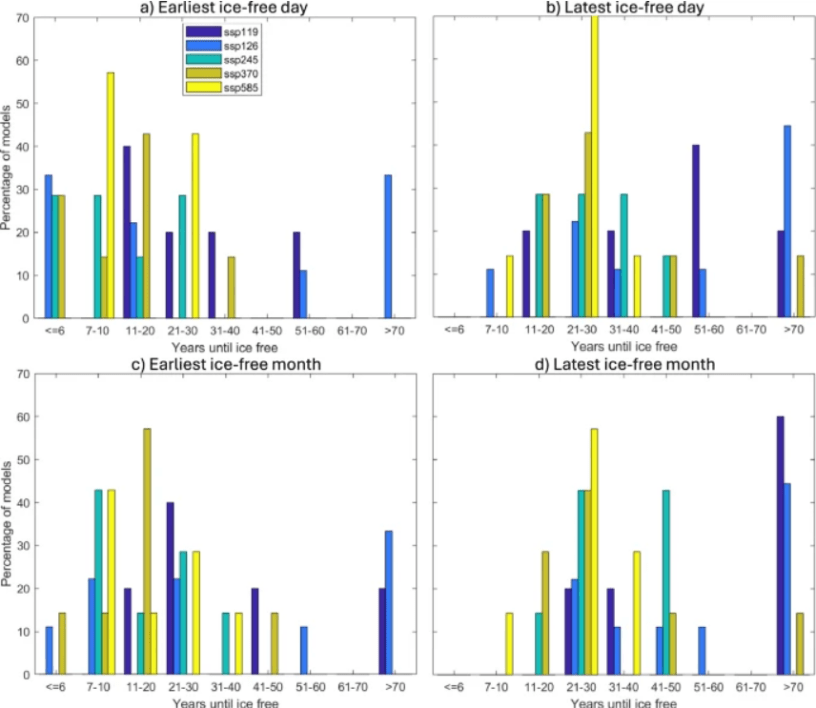
The Arctic is often referred to as the planet’s “climate canary,” signaling the urgency of global warming. Recent research published in Nature Communications under the title “The pace of Arctic sea ice decline” sheds light on alarming trends in the Arctic Ocean. The study reveals that the first ice-free summer in the Arctic may occur as early as the late 2020s, even under low greenhouse gas emissions scenarios. These findings challenge previous projections and highlight the accelerated pace of climate change in one of the most sensitive regions of the planet.
Key Findings from the Study
The research conducted by a team of international scientists combines advanced climate modeling with observational data to assess the future of Arctic sea ice. Key highlights include:
- Earlier Ice-Free Summers: Previous studies suggested the Arctic could become ice-free in summer by mid-century. This study revises that timeline, predicting an ice-free Arctic as early as 2027 and no later than the 2030s.
- Impact of Greenhouse Gas Emissions: The study emphasizes that even under low-emission scenarios, the Arctic will experience ice-free summers. This underscores the significant sensitivity of the region to global temperature increases.
- Accelerating Decline: Observational data shows that the rate of sea ice loss has surpassed earlier projections, with dramatic reductions occurring in the last two decades.
Historical Context and Shifting Projections
Past Projections
- 1990s: Initial models suggested that the Arctic would retain summer sea ice until at least the end of the 21st century.
- 2010s: Enhanced climate models began predicting ice-free conditions by 2040 to 2050.
- 2020s: Observational data revealed a much faster rate of decline, prompting revisions in projections to the 2030s or sooner.
What Has Changed?
The accelerated timeline is attributed to the following factors:
- Improved Climate Models: Modern models incorporate real-time data, enhancing accuracy.
- Feedback Loops: Processes such as reduced albedo (reflectivity) and increased ocean heat absorption amplify ice loss.
- Unanticipated Warming Events: Arctic temperatures have risen at nearly four times the global average, a phenomenon known as Arctic amplification.
Implications of an Ice-Free Arctic
Environmental Consequences
- Ecosystem Disruption:
- Marine species dependent on sea ice, such as polar bears and seals, face severe habitat loss.
- Disruptions in food chains will have cascading effects on Arctic biodiversity.
- Albedo Effect:
- The loss of reflective ice surfaces accelerates warming as darker ocean water absorbs more solar radiation.
- This creates a feedback loop that exacerbates global temperature increases.
- Ocean Currents:
- Changes in Arctic sea ice affect thermohaline circulation, disrupting global climate patterns.
Global Climate Impact
- Extreme Weather:
- An ice-free Arctic is linked to more frequent and severe weather events, including hurricanes, heatwaves, and flooding.
- Sea Level Rise:
- While melting sea ice does not directly raise sea levels, it contributes to the destabilization of Greenland’s ice sheet, which does.
Geopolitical and Economic Ramifications
- New Shipping Routes:
- Ice-free summers open up shorter Arctic shipping lanes, raising geopolitical tensions over resource access and territorial claims.
- Resource Exploitation:
- Easier access to oil, gas, and minerals may lead to increased extraction, further exacerbating environmental degradation.
Future Scenarios and Challenges
Near-Term Projections (2025-2035)
- The Arctic will likely experience its first ice-free summer by 2030.
- Extreme climate events linked to Arctic warming will become more frequent.
- Economic opportunities in shipping and resource extraction may clash with environmental concerns.
Long-Term Implications (2035 and Beyond)
- Permanent loss of summer sea ice will disrupt global climate systems.
- Arctic ecosystems will face irreversible changes, threatening biodiversity.
- Rising geopolitical tensions over Arctic resources and navigation rights.
Mitigation and Adaptation Strategies
Reducing Emissions
- Global Cooperation: Strengthening international agreements such as the Paris Accord to achieve net-zero emissions.
- Renewable Energy: Accelerating the transition to clean energy sources.
Protecting Arctic Ecosystems
- Conservation Efforts: Establishing marine protected areas to safeguard biodiversity.
- Monitoring and Research: Enhancing data collection and modeling to improve predictions and policy decisions.
Geopolitical Agreements
- Arctic Governance: Strengthening the role of the Arctic Council to manage resources and conflicts.
- Sustainable Development: Balancing economic opportunities with environmental protection.
Conclusion
The findings from the Nature Communications study provide a stark warning about the accelerated decline of Arctic sea ice. The potential for an ice-free Arctic within the next decade underscores the urgent need for global action to mitigate climate change and adapt to its inevitable impacts. Protecting the Arctic is not just a regional issue—it is a global imperative. By understanding the science, addressing the challenges, and fostering international collaboration, we can work toward a more resilient and sustainable future.
 Pacific Outlier -Where science meets mind, technology, and climate.